PROCESS
 Order now
 Prices
 Discounts
 About
 Reviews
 Samples
 FAQ
 Contacts
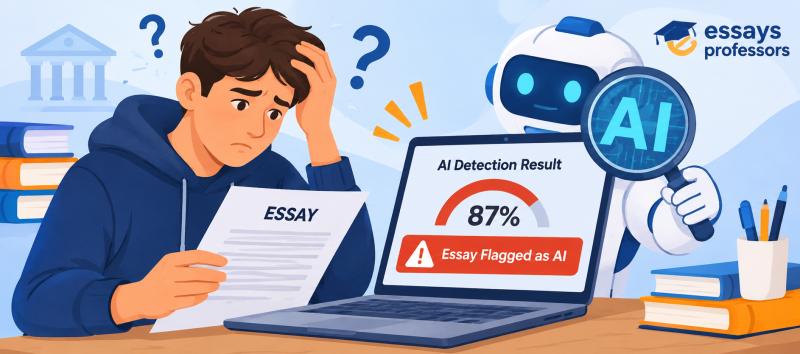
Artificial intelligence has changed how students research, write, edit, and prepare academic assignments. Tools such as ChatGPT and other AI-powered writing assistants can help brainstorm ideas, improve grammar, summarize information, and organize complex arguments. At the same time, universities and educators are increasingly concerned about AI-generated submissions and academic integrity. As a result, AI detection tools have become part of the academic evaluation process.
However, AI detection technology is not perfect. Students who write their assignments independently may sometimes receive unexpected detection results. A paper that contains original ideas, carefully researched arguments, and personal writing may still be identified as AI-generated by an automated system. Such situations raise important questions about fairness, reliability, and the consequences of AI detection in education.
So, what happens when an essay is flagged as AI? Does it automatically mean a student violated academic rules? Can a detector make mistakes? And what should students do if they believe a detection result is incorrect?
Understanding how AI detectors work, why errors occur, and how to respond to questionable results can help students approach these situations more confidently and responsibly.
Why Can a Human-Written Essay Be Flagged as AI?
An AI detector analyzes linguistic patterns, sentence structures, vocabulary choices, predictability, and other characteristics that may resemble text generated by artificial intelligence. Unlike plagiarism checkers, which generally compare content against existing sources, AI detection systems attempt to estimate whether certain passages may have been generated by AI.
An AI detection score is a statistical estimate, not definitive proof of authorship. A detector does not know who wrote a document, what software a student used, or how much time the writer spent researching. It analyzes the text and identifies patterns that its model associates with AI-generated content.
This limitation explains why an AI detector false positive can occur. Human writing and AI-generated text sometimes share similar linguistic characteristics, especially when authors use formal, structured, grammatically consistent language.
For example, consider two sentences:
- "The findings indicate that environmental policies can significantly influence urban development."
- "The results suggest that environmental regulations play an important role in shaping the growth of cities."
Both sentences are grammatically correct, relatively predictable, and written in a formal academic style. Such characteristics are common in academic writing, scientific papers, professional reports, and AI-generated content alike.
A detection system may interpret certain patterns as signals of AI involvement even when the text was written by a human.
8 Reasons Why AI Detectors Flag Human-Written Essays
An AI detector incorrectly flags human writing for several reasons. Understanding these factors can help students interpret detection results and recognize why automated systems should not be treated as the only evidence of academic misconduct.
1. Predictable academic language
Academic writing often follows established conventions. Students are expected to use formal vocabulary, avoid unnecessary repetition, organize arguments logically, and maintain a consistent tone.
These characteristics may make academic text statistically predictable. AI models also produce language that is often structured, grammatically correct, and relatively conventional.
Consequently, a human-written essay flagged as AI may contain patterns that overlap with those commonly found in AI-generated writing.
For example, a student writing about climate change may use expressions such as:
- "This study examines the relationship between..."
- "The findings demonstrate the importance of..."
- "Several factors contribute to this phenomenon."
- "It is essential to consider the implications..."
These phrases are common in academic writing. Their presence alone cannot establish whether AI was used.
2. Highly polished grammar and sentence structure
Students who spend considerable time editing their work may produce polished, consistent text. Grammar checkers, proofreading software, writing tutors, and professional editors can also help improve readability.
A paper with fewer grammatical errors, consistent sentence structure, and carefully selected vocabulary may sometimes resemble the output of an AI writing system.
Good writing should not automatically become suspicious. Students should not be encouraged to introduce intentional grammatical errors, awkward sentences, or unnecessary stylistic changes simply to influence a detection score.
3. Repetitive sentence patterns
Writers sometimes use similar sentence structures throughout an essay, especially when explaining technical concepts or presenting arguments.
For instance:
- "The first factor is..."
- "The second factor is..."
- "The third factor is..."
Such structures are useful for clarity and organization but may contribute to predictable writing patterns.
The same applies to repetitive transitions, paragraph structures, and conclusion phrases. These patterns may be associated with AI-generated content in some detector models, but they are also natural features of human writing.
4. Short essays and limited textual context
AI detection systems generally have less contextual information when analyzing short passages. A brief discussion post, abstract, paragraph, or short-answer assignment may not contain enough linguistic variation for a stable assessment.
For example, a 150-word response to a straightforward question might consist of several concise sentences with familiar vocabulary. There may be little room for personal examples, complex argumentation, stylistic variation, or distinctive writing patterns.
This can make the interpretation of AI detection results more challenging. The limitations of an AI detector false positive become particularly relevant when institutions use results from short assignments to support serious AI detection false accusations.
5. Language-learning and translation tools
Students who write in a second language may rely on dictionaries, grammar correction, translation tools, or language-learning software to express their ideas more clearly.
These tools can change sentence structure, vocabulary, word choice, and grammar. As a result, the final version may differ significantly from the student's initial draft.
For example, an international student may write a paragraph in their native language, translate it into English, and then edit the translated version for grammar and clarity. The final text may be grammatically consistent and stylistically polished, even though the ideas, research, and original composition belong to the student.
AI detection systems may not reliably distinguish between legitimate language assistance and AI-generated authorship in every situation.
6. Extensive proofreading and editing
Revising an essay is an essential part of academic writing. Students frequently improve their work by removing redundant phrases, reorganizing paragraphs, correcting grammar, refining arguments, and replacing informal expressions.
However, extensive editing can alter the linguistic characteristics of the original draft.
Consider a student who writes:
"I think this method is useful because it helps researchers understand the problem better."
After revision, the sentence becomes:
"This methodological approach provides researchers with a more comprehensive understanding of the underlying problem."
The revised version is more formal and precise. Nevertheless, the change in vocabulary and sentence structure does not indicate that AI generated the sentence.
7. Writing about conventional or technical topics
Some academic subjects naturally involve specialized terminology, established definitions, and standardized explanations.
Students writing about mathematics, law, medicine, economics, engineering, or scientific methodology may use similar vocabulary and sentence patterns because the subject requires precision.
For example, medical students may frequently use terms such as "clinical outcomes," "diagnostic criteria," or "treatment efficacy." Law students may rely on formal terminology, statutory language, and structured argumentation.
The use of discipline-specific language should not be interpreted as evidence of AI authorship without additional context.
8. Limitations of AI detection technology
AI detectors are developed using training data, statistical methods, classification models, and other techniques. Their performance depends on the types of text they analyze, the languages they support, the length of documents, the model versions, and the conditions under which they are tested.
Different tools may produce different results for the same document. Some may classify a passage as likely human-written, while others may identify potential AI involvement.
An AI detection false positive is therefore not simply an unusual technical error. It reflects a broader challenge: distinguishing between human and machine-generated language is not always straightforward.
What Happens If Your Essay Is Flagged by AI?
When a professor, instructor, or university receives a detection result suggesting that an assignment may contain AI-generated text, the next steps depend on the institution's academic integrity policy.
Being flagged as AI does not automatically mean a student will receive a failing grade or be accused of misconduct. A detector result may prompt a teacher to review the paper, request additional information, or discuss the assignment with the student.
Possible outcomes include:
- Additional review: The instructor examines the essay, its sources, structure, and content more carefully.
- A conversation with the student: The student may be asked to explain their argument, research methods, or writing decisions.
- A request for supporting evidence: Drafts, notes, outlines, research materials, or version history may be requested.
- An academic integrity investigation: If the institution believes its rules may have been violated, a formal review may follow.
- No further action: The instructor may determine that the detection result does not provide sufficient evidence of misconduct.
Policies differ between universities, departments, and individual courses. Some institutions restrict AI tools, while others permit AI-assisted editing, brainstorming, or research under specific conditions.
For this reason, students should review their course instructions and university policies before assuming what a detection result means.
AI Detection and Student Appeals: How to Respond to Questionable Allegations
AI detection accuracy for students: An AI detection student appeal may become necessary when a student believes a detector result is inaccurate or when an academic integrity accusation is based primarily on automated detection.
The most effective response is usually calm, factual, and supported by documentation. Instead of focusing only on the detection score, students should demonstrate how they developed the assignment, conducted research, and arrived at their final conclusions.
Step 1. Review the academic integrity policy
Before responding, check the relevant university or course policy. Find out:
- Whether AI writing tools are prohibited or permitted.
- Whether grammar correction, translation, and proofreading tools are allowed.
- Whether AI use must be disclosed.
- What procedures apply to suspected academic misconduct.
- Whether students have the right to appeal or request a formal review.
This information helps clarify what the institution is evaluating: prohibited AI use, undisclosed assistance, plagiarism, or another issue.
Step 2. Preserve drafts and document history
Students should collect materials that demonstrate how their work developed over time. If an allegation arises, authentic documentation can help provide context about the writing process.
Useful materials include:
- Early drafts and revised versions of the essay.
- Document version history from Google Docs, Microsoft Word, or other writing platforms.
- Research notes and outlines.
- Screenshots or records of relevant edits, if available.
- Bibliography drafts and source annotations.
- Feedback from instructors, tutors, or peers.
- Notes from brainstorming sessions.
- Records of research and source selection.
Students should preserve genuine records rather than create or alter evidence after an accusation. The purpose of documentation is to demonstrate the actual process, not manufacture proof.
Step 3. Explain your writing process
Students should be prepared to explain how they developed their ideas and arguments.
For example, if an essay discusses the impact of social media on adolescent mental health, a student might explain:
- How they selected the topic.
- Which studies or sources they initially found.
- Why they chose specific research findings.
- How they organized the argument.
- Which paragraphs they revised and why.
- How they interpreted the evidence.
- What limitations they identified in the research.
A student who understands their paper and can explain their reasoning may provide valuable context for an instructor's evaluation.
Step 4. Ask for clarification about the detection result
Students can request information about the tool, the report, and the specific passages that were flagged.
Reasonable questions include:
- Which sections of the essay were identified?
- Was the entire paper evaluated or only selected passages?
- What detector was used?
- Is the result being treated as preliminary information or evidence of misconduct?
- What additional information would help the instructor evaluate the assignment?
Not every institution will provide all technical details, but asking respectfully can help clarify the situation.
Step 5. Prepare a formal appeal if necessary
If a student believes the accusation is unfair, they should follow the university's official appeal procedure.
An appeal may include a concise explanation of the circumstances, relevant documentation, and a request for a review that considers evidence beyond the automated score.
Avoid aggressive language, personal attacks, or claims that a particular detector is completely unreliable. Instead, explain why the result may not accurately reflect the authorship of the paper and provide verifiable supporting evidence.
Example of a student response
Sample email to an instructor
Dear Professor,
I am writing regarding the AI detection result associated with my recent assignment. I was surprised by the result because I wrote the paper myself and developed the arguments using my research and notes.
I would be happy to provide earlier drafts, outlines, research notes, and document version history to demonstrate how the assignment was developed. I can also explain the sources I used and the reasoning behind the main arguments.
I understand the importance of academic integrity and would appreciate the opportunity to discuss the result and provide additional information before any conclusions are reached.
Thank you for your time and consideration.
Best regards,
[Student Name]
This type of response is respectful, direct, and focused on evidence. It does not assume that the instructor is acting unfairly, but it clearly requests an opportunity to explain the writing process.
How Students Can Document Their Writing Process to Prove Authorship
Documentation is useful not only when students face accusations but also as a regular academic practice. Keeping records of research, planning, and revision can make writing more organized and transparent.
| Evidence | How it helps |
|---|---|
| Drafts | Shows how the text developed from initial ideas to the final version. |
| Document version history | May reveal the sequence and timing of edits and revisions. |
| Research notes | Demonstrates engagement with source material and the development of arguments. |
| Outlines | Shows how the paper was structured before the final text was written. |
| Annotated sources | Provides context about source selection and interpretation. |
| Feedback and comments | Shows how suggestions or critiques influenced revisions. |
| Assignment planning | Helps establish the initial direction and development of the project. |
| Explanation of arguments | Allows students to demonstrate their understanding of the paper's ideas. |
For example, a student writing a literature review might have an initial research question, a list of selected articles, a thematic outline, several paragraph drafts, and a final paper. Taken together, these materials provide a more comprehensive picture of the writing process than a single automated score.
Such evidence does not guarantee that an institution will dismiss an allegation, but it may help an instructor evaluate the circumstances more fairly.
Frequently Asked Questions (FAQ)
1. What to do if your essay is flagged as AI?
If your essay is flagged, review the detection report, check your university's academic integrity policy, and collect evidence of your writing process. Preserve drafts, notes, document version history, and sources. If necessary, contact your instructor and request an opportunity to explain your work.
2. What happens if your essay is flagged by AI?
A flagged essay may undergo additional review. An instructor may ask questions, request supporting documentation, or initiate 'AI detection and an academic integrity' procedure. However, detection results do not automatically establish misconduct, and the consequences depend on the institution's policies and the circumstances of the assignment.
3. What to do if a professor accuses you of using AI?
Remain calm and respond professionally. Review the assignment requirements, gather genuine documentation, and ask which passages or evidence raised concerns. Explain your writing process and follow the university's procedures for responding to academic integrity allegations. Or you can ask for a professional help from Essays Professors.
4. How to prove an essay was written by a human?
There is no single document or test that definitively proves human authorship in every situation. However, drafts, notes, document version history, source annotations, outlines, and the ability to explain your arguments can help demonstrate how the paper was developed.
5. How to appeal an AI detection accusation?
Follow your institution's official appeal process. Prepare a clear explanation of why you believe the accusation is incorrect, provide relevant documentation, and request a review that considers your writing process and other evidence rather than relying solely on an automated detection result.
6. Why was my essay flagged as AI if I wrote it myself?
Your essay may contain linguistic patterns associated with AI-generated text, such as predictable sentence structures, formal vocabulary, consistent grammar, or repetitive transitions. Short text, technical writing, extensive proofreading, and language assistance may also affect detection results.
7. How to prove you didn't use AI on an essay?
Preserve authentic evidence of your writing process, including original drafts, outlines, research notes, source annotations, and document history. You can also explain your research decisions, the development of your arguments, and how you revised the assignment.
8. Can AI detectors falsely accuse students?
Yes. AI detection systems can produce false positives by classifying human-written text as AI-generated or AI-assisted. Their results are not definitive proof of authorship and should be interpreted carefully, especially when academic consequences are involved.
9. How to document the writing process to prove authorship?
Save drafts, outlines, notes, source lists, document version history, and feedback throughout the writing process. Keeping these materials from the beginning of an assignment is more useful than attempting to reconstruct the process after a concern arises.
10. What evidence can students provide against an AI accusation?
Students may provide original drafts, document history, research notes, outlines, annotated sources, feedback, and a detailed explanation of how they developed the paper. The relevance of each type of evidence depends on the assignment and the university's review procedure.
Conclusion
AI detection tools are becoming increasingly common in academic environments, but their results should not be interpreted as definitive evidence of misconduct. Human writing can share linguistic characteristics with AI-generated text, and automated systems may struggle to distinguish between different forms of writing assistance, editing, and original composition.
When an essay receives an unexpected detection result, students should focus on transparency, documentation, and communication. Understanding university policies, preserving authentic drafts, maintaining research notes, and explaining the development of an assignment can help students respond constructively to questionable allegations.
At the same time, educators and institutions should recognize the limitations of automated detection and consider multiple sources of evidence before making decisions that may affect a student's academic record.
Responsible AI detection should support academic integrity, not replace critical judgment, fair procedures, and meaningful evaluation of student work.